Key Takeaways
- A PEO can be a real fit for very small companies that want one provider handling payroll, benefits, and HR.
- The reasons companies leave a PEO show up in a predictable pattern: fee creep, call-center support, cookie-cutter benefits, and locked annual contracts.
- Most companies hit a moment somewhere around 75 to 100 employees where the PEO economics shift, and the bundled model starts to feel like it’s costing more than it’s giving.
- There are five real categories of HR support to choose from, and they’re more different than the marketing makes them sound.
- The right move depends on how much control you want, how much help you need, and how comfortable you are with someone else being the legal employer of your team.
You may have had this thought already. You’re sitting at your desk, looking at the latest PEO invoice, and you’re wondering: “When did this get so expensive, and why can’t I get anyone on the phone?”
If that’s you, you’re not alone, and you’re not stuck. There are real alternatives. The right one depends on how big you are, how much help you need, and how much control you want.
If you’re looking at a PEO for the first time and trying to figure out whether it’s the right call, this is for you too. We’ll walk through when each option makes sense and the questions to ask before you sign anything.
What a PEO Actually Is, in Plain Language
A Professional Employer Organization is a company you hire to handle payroll, benefits, workers’ comp, and HR for your business.
The thing that makes a PEO different from other HR support is the legal arrangement underneath it. When you sign with a PEO, you enter what’s called a co-employment relationship.
On paper, the PEO becomes the employer of record for tax, benefits, and workers’ comp purposes. You still run your business, you still hire and fire, you still set the culture. But the PEO is technically the employer too.
That’s why a PEO can pool your team into bigger benefit plans alongside other clients. It’s why you might get better workers’ comp rates than you could shop on your own. It’s also why leaving a PEO is often more challenging than just canceling a subscription. You’re unwinding an employer relationship, not just a vendor contract.
When a PEO Is Actually the Right Call
It’s worth saying clearly: PEOs are a good fit for plenty of small companies.
If you’re an owner doing everything yourself and you don’t have an HR person, a PEO can take work off your plate and improve the quality of your benefits.
The fit profile usually looks like this:
- You’re under about 25 employees. Small enough that hiring a full-time HR person doesn’t pencil out.
- You don’t have any internal HR capacity. No HR generalist, no office manager doubling up, nothing.
- You want benefits access you can’t get on your own. PEOs pool your team into larger benefit plans, which can sometimes mean better rates or more carrier options than a standalone small business can buy.
- You want one provider doing payroll, benefits, and workers’ comp together. You’d rather pay one bill than manage four vendors.
- You’re comfortable with the co-employment arrangement and being locked into an agreement.
If most of those describe you, a PEO is worth looking at.
Why Companies Outgrow Their PEO
The pattern is pretty consistent. We see the same five complaints from companies thinking about leaving:
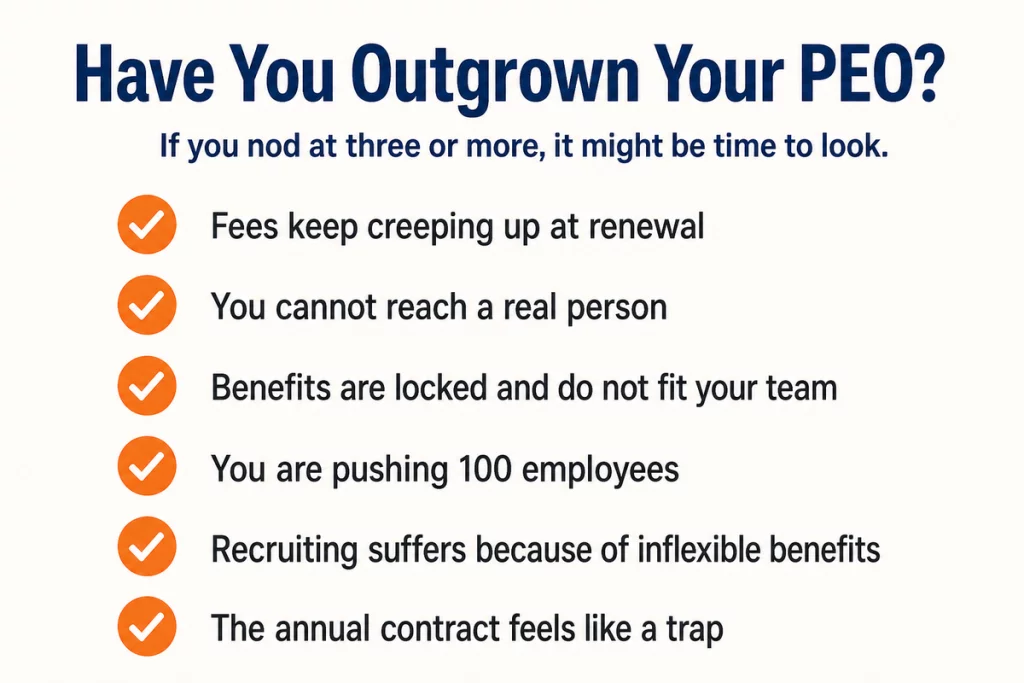
1. The fees keep creeping up. What started as a clear monthly cost slowly turns into a list of line items. “Hourly fees” appear with no explanation. A common phrase from owners: “I feel like we’re getting nickel-and-dimed.”
2. You can’t get anyone on the phone. Calls route to a general support line. The dedicated rep you started with is gone. Email responses take days, sometimes weeks. When something is urgent, you’re on hold.
3. The benefits feel cookie-cutter. You’re locked into the carriers your PEO uses. Your team is paying for plans that don’t match what they actually need. You can’t shop or negotiate independently.
4. You’re locked into an annual contract with termination penalties that make leaving feel financially impossible.
5. The honeymoon ended. When you signed, things felt great. A year in, the service is different. You ask yourself, “What am I actually paying for?”
There’s also a more real inflection point: Most PEO industry data points to a stage somewhere between 75 and 100 employees where the economic case for a PEO starts to weaken.
Below that size, you can’t easily replicate what a PEO offers on your own. Above it, you can. You can hire an HR person, you can shop your own benefits with a broker, and the per-person PEO fee starts to add up.
The Real Alternatives to a PEO
Here’s where most articles list the same three or four options and call it a day. The reality is broader. There are five genuinely different categories of HR support, and they’re not interchangeable.
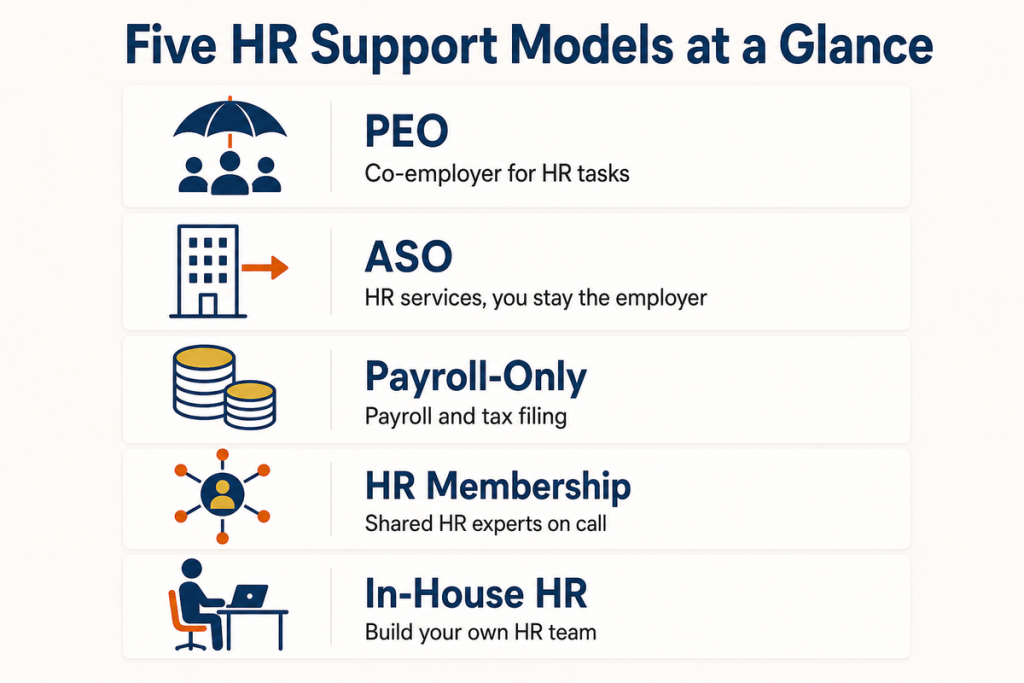
Administrative Services Only (ASO). An ASO provides a lot of the same payroll and HR admin a PEO does, without the co-employment relationship. You stay the legal employer of your team. You shop your own benefits, your own workers’ comp, your own carriers. The ASO handles the back-office work. You get more control, you do more of the buying, and the math often works out cheaper than a PEO once your team gets past the very small stage.
Payroll-only providers. Companies like ADP, Paychex, and Gusto sold standalone, without the PEO bundle. Solid at running payroll. They’ll handle tax filings and direct deposit and the basics. They’ll sell you bolt-on HR software too. What they don’t really do is HR strategy, employee relations, or “what should I do about this employee” advice. If you have someone internally who can run HR, payroll-only is enough. If you don’t, the gap shows up the first time something complicated happens.
Association-based HR support. This category is missing from most “PEO alternatives” articles, and it’s the one we know best because it’s what we do. An employer association like ours offers ongoing HR access through membership. That looks like a hotline you can actually call when you have a question, a real HR partner who knows your business, training for your managers, and help with compliance, handbooks, comp, and recruiting when you need it. There’s no co-employment. You stay the employer. You’re not on a long-term contract. You pick the level of support that fits your team. It works for companies that want a relationship with people who know employment law and your situation, not a portal and a 1-800 number.
On-demand HR consulting. Project-based or retainer help from an HR consultant. You bring them in for a specific need: handbook, comp study, leave policy, an investigation. The work gets done, they leave, you call them again next time. Useful when you have a specific problem and a defined budget. Less useful when you need someone consistent who actually knows your business over time.
In-house HR. Hiring a full-time HR person. The right move at a certain size. The trick is knowing when. The 2026 average HR generalist salary runs from about $63,000 to $83,000 depending on experience and region, per PayScale and Glassdoor. Loaded with benefits, tools, and software, all-in costs typically land in the high five figures to low six figures. That’s a real number, and it presumes you hire the right person on the first try. Most companies underestimate how much of the work an HR generalist actually has to outsource anyway, especially around legal, comp, and benefits.
How to Compare Your Options Side by Side
If you’re trying to actually decide, the differences come down to a few questions. Here’s how the five options stack up.
| Option | Who’s the legal employer | Pricing model | Contract length | Level of human support | Best fit |
|---|---|---|---|---|---|
| PEO | The PEO (co-employment) | Per person per month, or % of payroll, often bundled | Annual, with termination penalties | Variable; often degrades after onboarding | Under ~25 employees, no internal HR, want one provider |
| ASO | You | Per person per month, or flat fee | Often month-to-month or annual without heavy penalty | Mostly admin and software; some advisory | 25 to 200 employees, want control, have someone internal to run point |
| HR Membership | You | Annual membership, plus services as needed | Annual membership, no co-employment lock-in | Hotline access, training, on-demand specialists | You have someone running HR internally and want backup, expertise, and a hotline to call |
| HR Business Partner | You | Monthly tiered fee (e.g., 10, 20, or 30 hours per month), customizable | Month-to-month tier flexibility | A dedicated HR Business Partner working with you ongoing, full specialist team behind them | You need an embedded HR person handling things proactively, but don’t want or need a full-time hire |
| In-house HR | You | HR generalist salary plus benefits, plus tools | Permanent (or until they leave) | Full, until they’re out at a doctor’s appointment | 100+ employees with complex needs and a real budget |
The lines aren’t bright. Plenty of companies use a combination: an in-house HR generalist plus an HR membership for harder questions, or an HR Business Partner plus a separate payroll provider. The bundle is rarely the cheapest answer or the best one.
How to Tell If You’ve Outgrown Your PEO
If you’re already in a PEO and trying to figure out whether to leave, here’s the practical checklist. If three or more of these describe you, it’s probably time to look at alternatives.
- Your benefits feel cookie-cutter. The plans available don’t match what your team actually wants or can afford.
- You’re paying for things you don’t use. Onboarding tools, learning modules, recruiting features that nobody on your team has logged into in months.
- The fees keep creeping up. Your invoice today is meaningfully higher than a year ago, and you can’t trace why.
- You can’t get anyone on the phone. When you have a real question, you’re stuck in a queue or waiting days for an email response.
- You’re approaching or past 75 to 100 employees. The PEO math gets less favorable as you grow.
- Your team has gotten more sophisticated. You need actual HR strategy, not just payroll and benefits administration.
- You want to choose your own benefits broker, payroll vendor, or workers’ comp carrier, and your PEO won’t let you.
There’s a small but useful body of research on this question. A decision-making model for small and medium-sized firms, published in the New England Journal of Entrepreneurship, walks through how the right HR setup tends to evolve as companies grow.
Questions to Ask Any HR Support Provider Before You Sign
Whatever you’re evaluating, these are the questions worth asking. The answers tell you a lot about what life will actually look like a year from now.
- Are you the employer of record, or am I? Co-employment is consequential. Know which one you’re agreeing to.
- What’s your contract length, and what does it take to leave? “Annual with auto-renewal” and “month-to-month” are very different commitments.
- How do you price? Per person, percent of payroll, flat fee, membership, à la carte? Get it in writing.
- What can I expect to pay one year in versus day one? Ask directly about fee escalation.
- How do you charge for adding or removing services? The bundle that fits today often doesn’t fit in 18 months.
- When I call with a question, who answers? How fast? Is there a dedicated person or a queue? What happens if my person leaves?
- Am I locked into specific benefit carriers, or can I shop? This is the question most organizations forget to ask until it matters.
- What happens if I want to bring HR in-house later? Some providers make the transition easy. Others don’t.
How EANE Fits Into This Picture
We’re an employers association, not a PEO and not a software company. We’ve supported small and mid-sized employers across New England for decades, and we offer HR support in two varieties depending on what you actually need:
- HR Membership: For companies that have someone running HR internally and want expert backup. You get hotline access, training your managers will actually use, and a full specialist team you can pull in for comp, recruiting, compliance, and the harder employment questions.
- HR Business Partner: Our RightFit HR program provides a dedicated HR Business Partner who works with you on an ongoing basis in monthly tiers you can flex up or down. Built for companies that need an embedded HR person handling things proactively, without committing to a full-time hire.
A few things worth knowing about how both options work, especially if you’re comparing us to a PEO:
- No annual lock-in. With RightFit HR, you can change your tier month-to-month as your team’s needs change. With membership, you renew annually but you’re not locked into long-term contracts the way a PEO would tie you up.
- Transparent pricing. No surprise innovation fees, no auto-escalations.
- Independent. We don’t sell insurance and we don’t sell payroll. We can refer you to a broker or a payroll vendor we trust.
- A real human you can talk to, with a full specialist team behind them when you need comp, recruiting, training, or compliance help.
- You stay the employer. No co-employment. You keep control over your benefits, your team, and your culture.
If you want a dedicated HR partner without the PEO contract, RightFit HR is built for that conversation. If you have HR coverage and want expert backup plus training and a hotline you can actually call, our HR Membership is the right starting point. You can also browse the full set of services on our HR Solutions page.
Whatever you decide, the goal is the same: a setup that lets you focus on running your business with confidence that the HR side is handled. Your EANE team is here whenever you want to figure out together what that looks like for your team.