Key takeaways
- ChatGPT can draft a handbook in minutes. It can’t tell you whether that handbook is legal where your people work.
- As a drafting aid, AI can be useful: an outline, a first pass on everyday policies, plain-language cleanup, or even review.
- The trouble starts with state law. Massachusetts, Connecticut, and Rhode Island handle even basic sick leave differently, and AI trained on older data misses recent changes.
- A handbook is a legal document. Wording that’s too vague or too specific can undermine at-will employment or read as a binding promise you never meant to make.
The employee handbook has been sitting on your to-do list for months, and ChatGPT will draft one in ninety seconds for free. We get why that’s tempting. When you’re the whole HR department, or owner who is the default “HR person,” cheap and fast is a real argument.
So can ChatGPT write your employee handbook? The short version: it can write you a handbook. Making that handbook right for where your people work, and keeping it that way, is a different story.
The short answer: ChatGPT can draft a handbook, but will it be compliant?
Yep, ChatGPT can produce a full employee handbook, formatted and readable, faster than you could open a blank document. That part is real, and we won’t pretend otherwise.
The catch is what it can’t do. It can’t confirm that a single policy in that document is legal in your state. It doesn’t know you have eight employees in Worcester and three in Providence. It’s not always up-to-date on which laws changed last month. And when it isn’t sure about something, it tends to fill the gap with wording that sounds right rather than stopping to flag it.
And being confidently wrong is dangerous. A handbook may read casually, but it works like a legal document. Your managers make decisions from it. If you ever land in a dispute, an attorney on the other side gets to read it back to you, line by line. “The AI wrote it” is not a defense.
What ChatGPT and handbook templates are genuinely good for
We’re not here to tell you AI is useless. Used as a drafting aid, it can be helpful. Here’s where it may be able to help:
- A starting outline. Ask for the sections a handbook usually includes and you’ll get a reasonable table of contents to react to. Staring at a blank page is half the battle, and this makes it easier.
- A first pass on the everyday stuff. Dress code, general conduct language, the tone of a welcome letter. The low-risk, non-legal sections can be drafted and save you real typing.
- Plain-language cleanup. Paste in a clunky policy you already had reviewed and ask it to make the wording clearer.
- A smarter search of your own document. Some firms load their existing, lawyer-approved handbook into a custom assistant so staff can ask it questions, an approach the Journal of Accountancy has walked HR teams through. The key word is existing: the AI answers from a document a human already got right.
Notice the pattern. AI can help you draft, rearrange, or explain content that a person still owns. It gets shaky the moment you ask it to be the authority on what the law requires.
Where AI-written handbooks fail employers
This is where a “free” handbook gets expensive. Employment law is set state by state, and New England is a patchwork of varying laws. If your handbook doesn’t match the state your people work in, it isn’t protecting you, no matter how polished it sounds.
Take something as ordinary as paid sick leave. Three neighboring states, three different rulebooks:
- Massachusetts: employees earn one hour of sick time for every 30 hours worked, up to 40 hours a year. Employers with 11 or more employees have to pay for it; smaller ones can offer it unpaid. (mass.gov)
- Rhode Island: the accrual rate is one hour for every 35 hours worked, and the paid requirement starts at 18 employees, not 11. (RI DLT)
- Connecticut: a 2024 law is phasing paid sick leave in by size. It covered employers with 25 or more employees in 2025, drops to 11 or more in 2026, and reaches nearly every employer in 2027. (CT.gov)
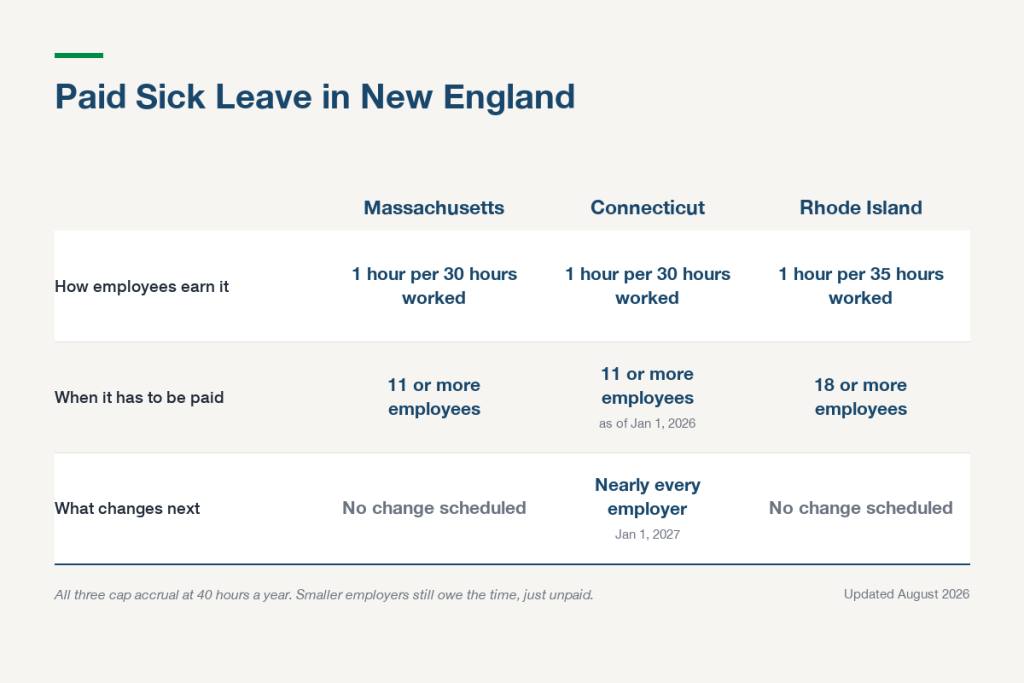
Same basic policy. Different math, different size thresholds, different timelines. A handbook generated from a generic prompt will confidently give you one version of “sick leave” and leave you guessing which state, if any, it fits.
Connecticut is a great example of what can go wrong when AI is “frozen in time.” A model trained a year or two ago doesn’t know Connecticut’s threshold dropped to 11 employees in 2026. Ask it today and it might tell a 15-person Hartford organization they’re exempt, which was true under the old rules and is wrong now. You’d never know the answer had expired.
Then there’s Massachusetts Paid Family and Medical Leave, a program that doesn’t exist in most of the country. It runs up to 26 weeks a year, carries employer notice requirements, and its contribution rates and required poster change annually; the 2026 maximum benefit is $1,230.39 a week (mass.gov). A national template has no reason to include any of it, and an AI draft that does mention it is often working from last year’s numbers.
When Stanford researchers tested general-purpose models like ChatGPT on specific legal questions, the models produced wrong or made-up answers 69% to 88% of the time.
And it shows up in real handbooks. Forbes documented a New York firm whose ChatGPT-written handbook had no anti-harassment policy at all, a gap that fell on the employer once a complaint came in. Another company’s AI draft promised five days of bereavement leave in a state that required ten. Both documents looked finished. Neither one was.
The at-will and “binding contract” language AI gets wrong
Missing policies are the obvious risk. The subtler one is the language AI puts in. A handbook can be used against you when the wording is too definite.
Say AI writes a disciplinary policy: a verbal warning, then a written warning, then termination. It reads well. But the first time you need to fire someone immediately for something serious, you’ve departed from your own written process, and that inconsistency becomes something that an employee can use against you.
At-will employment is the same story. Most New England employers operate at-will, meaning either side can end the relationship at any time. Handbook language that promises fair treatment, permanent employment, or a guaranteed sequence of steps can quietly chip away at that, and in many states a definite-enough handbook can be read as an implied contract.
AI is aiming for one thing: a document that sounds thorough and professional. It’s not weighing whether those confident promises are ones you can keep. And promising more than you can consistently deliver is what gets an employer into trouble.
Drafting your handbook
So, can ChatGPT write your employee handbook? It can hand you a solid first draft, and if that gets you off the blank page, use it. The mistake is treating that draft as the finished product and putting it in front of your team.
If you’d rather hand it off, that’s what our Handbook Development & Review service is built for: we build and review handbooks from an HR and compliance standpoint, tuned to the state your people actually work in, and we keep them current as the rules change.
If what you really need is someone to own HR for you, that’s the job of an HR Business Partner.
If you’re staring at an AI draft right now and quietly wondering what it missed, that’s a good instinct. Let’s take a look at it together.