A lot of workplace friction starts with style. One person wants the bottom line in the first sentence, another wants the background first, and each reads the other as rude or slow. A shared way to talk about those differences fixes a surprising amount of it.
Our half-day DiSC workshop gives your people that shared language. Participants complete the DiSC assessment beforehand, then spend the session learning their own style and practicing how to adapt to colleagues whose styles differ.
What participants learn
By the end of the workshop, participants can:
- Identify their behavioral style from their personal DiSC report.
- See how their tendencies affect others, including how a habit that feels efficient to them can come across as abrupt.
- Recognize the strengths and limits of each style, including their own.
- Adapt their approach to communicate more effectively with people whose styles differ, in meetings, feedback conversations, and everyday requests.
- Commit to a personal action plan for the situations where adapting matters most to them.
How the DiSC model works
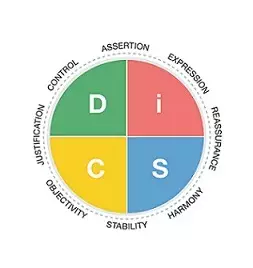
DiSC describes four behavioral styles. Most people lean toward one or two styles, and everyone uses all four to some degree.
| Style | Tends to focus on | Often appreciates |
| D: Dominance | Results, speed, and decisions | Directness and the bottom line first |
| i: Influence | Enthusiasm, relationships, and persuasion | Recognition, energy, and collaboration |
| S: Steadiness | Stability, support, and cooperation | Patience, clear expectations, and time to adjust |
| C: Conscientiousness | Accuracy, quality, and logic | Details, data, and time to think |
DiSC describes preferences and tendencies. The assessment doesn’t measure intelligence, skill, or job performance.
What happens before, during, and after the workshop
Before. About a week before the session, each participant receives a link to the online DiSC assessment, which takes about 15 to 20 minutes.
During. The facilitator walks through the DiSC model, helps participants read their own reports, and runs exercises where they challenge their assumptions about colleagues’ styles. Most of the session is discussion and practice.
After. Participants keep their personal DiSC report and the action plan they built in the session. The report is a reference they can return to before a difficult conversation or a new working relationship.
Bringing DiSC to your whole team
DiSC works best when everyone on a team shares the language. We run private sessions live virtual or onsite for intact teams, leadership groups, and groups of new managers, and we can focus the exercises on situations your team handles, such as handoffs between departments or feedback between a manager and their reports. Contact us for group pricing.
For managers, DiSC pairs well with Communication Skills for Leaders and Managing Diverse Workstyles. We wrote about one practical use in what a DiSC profile tells you about how your managers give feedback. Massachusetts employers may be able to offset training costs through the state’s Workforce Training Fund, and our grant team can tell you which program fits.
Frequently asked questions
What does the workshop cost, and is the DiSC assessment included?
$325 per person for EANE members and $385 for non-members (2026; 2027 pricing appears at registration), including the online DiSC assessment and personal report. Register three or more people for the same session and save 10%. Private team sessions are priced by group.
How long is the workshop, and is it live?
Three and a half hours, from 8:30 a.m. to noon, live with a facilitator. Public sessions are virtual and open to individuals. Private team sessions can be virtual or onsite.
Is the DiSC assessment available in Spanish?
Yes. Participants can request the Spanish version of the assessment, and their report comes back in Spanish. The workshop itself is delivered in English.
Does this workshop count for HRCI or SHRM recertification credits?
Yes. The workshop is approved for 3.5 HRCI Business credits and 3.5 SHRM credits.
What happens if someone doesn’t finish the assessment before the session?
They’ll still get value from the discussion, but they won’t have a personal report to work from. Contact us as soon as possible if a participant hasn’t received or completed the assessment.
Should we use DiSC to make hiring decisions?
DiSC is a development tool for understanding working styles. It was never designed or validated for selecting candidates, so we recommend against using it in hiring.
How is DiSC different from Myers-Briggs or CliftonStrengths?
DiSC focuses on observable behavior at work, especially communication, which makes it easy to apply in daily interactions. Myers-Briggs looks at broader personality preferences. CliftonStrengths identifies talents to build on. Many organizations use more than one.