Key takeaways
- Massachusetts employers with 25 or more MA employees have had to put a good-faith pay range in every job posting since October 29, 2025. Employers with 100 or more MA employees who already file federal EEO reports also owe workforce and pay data to the state.
- Connecticut requires a wage range on request today, and adds a posting requirement (the range plus a general description of benefits) on October 1, 2026. Rhode Island requires a range on request and bans salary-history questions, with no posting mandate yet.
- The three states don’t share one rule, so national templates and generic software routinely tell you the wrong thing for the state your worker is in.
- The number in the posting is the easy part. The real exposure is a range your pay practices can’t defend: pay compression, undocumented decisions, and gaps a published range makes obvious.
- Complying well comes down to your compensation structure. Right-sized regional wage data, plus a person who maps it to your roles, beats a national spreadsheet with 150 columns.
If you run HR, operations, or finance for a company in Massachusetts, the pay-transparency deadline has already come and gone. Since October 29, 2025, employers with 25 or more Massachusetts employees have had to include a salary range in every job posting. Connecticut is close behind with a posting rule that starts October 1, 2026, and Rhode Island already makes you hand over a range when an applicant asks.
Most national guidance treats all three states like one rule. They work differently, and posting a number is the easy part. The harder part is making sure your pay practices can stand behind the ranges you publish, in every state where your people work.
What Massachusetts requires now: the 25-employee posting rule and the 100-employee wage report
Massachusetts passed An Act Relative to Salary Range Transparency in July 2024, and the core posting requirement took effect October 29, 2025. If you employ 25 or more people whose primary place of work is in Massachusetts, you have to include a pay range in your job postings.
A few specifics are worth getting right:
- What counts as covered. The rule applies to internal and external postings, including the ones a third-party recruiter runs for you. You also have to give the range to an employee you’re promoting or transferring, and to any applicant or current employee who asks.
- How you count to 25. Include full-time, part-time, seasonal, and temporary workers whose primary place of work is Massachusetts. Remote roles tied to a Massachusetts worksite count too, which catches more employers than they expect.
- What the range has to be. The salary or hourly range you “reasonably and in good faith expect to pay” at the time of posting. You don’t have to disclose bonuses or benefits, though commission and piece-rate ranges are in.
For a first violation, you get a warning and two business days to fix it, at least through October 29, 2027. The stakes go past the posting, though. The pay information you disclose can be used to support an employee’s wage-discrimination claim, so the range can become a larger issue if not calculated properly.
There’s a second Massachusetts requirement that catches larger employers. If you have 100 or more Massachusetts employees and you already file federal EEO reports like the EEO-1, you also have to submit that workforce and pay data to the Secretary of the Commonwealth. EEO-1 filers report annually, with the first filing due February 1, 2025; other EEO report types run on an every-other-year schedule. This one runs in the background, and it’s easy to miss until it’s late.
Why Connecticut and Rhode Island don’t follow the same rules as Massachusetts
Multi-state employers get tripped up here, because the New England states genuinely differ from each other.
Connecticut requires you to give a wage range when an applicant asks, or before you make an offer, whichever comes first. That’s the rule today.
Starting October 1, 2026, it gets broader: every employer will have to put the wage range plus a general description of benefits right in the job posting. And unlike Massachusetts, Connecticut lets employees and applicants sue over violations.
Rhode Island takes another approach. Under its Pay Equity Act, you have to provide the wage range for a role when an applicant requests it, and you can’t ask about salary history. Rhode Island stops short of requiring you to post ranges in your ads. It’s moving in the same direction as its neighbors, just not there yet.
So picture a 60-person company hiring for a remote role that could sit in any of the three states. If the job’s primary place of work is Massachusetts, the range belongs in the posting today. If it’s Rhode Island, you skip the posting but still owe the range on request, and you can’t ask about pay history. If it’s Connecticut, you’re on request for now and in the posting once October 1, 2026 arrives. Which state’s rule applies depends on where the role is based.
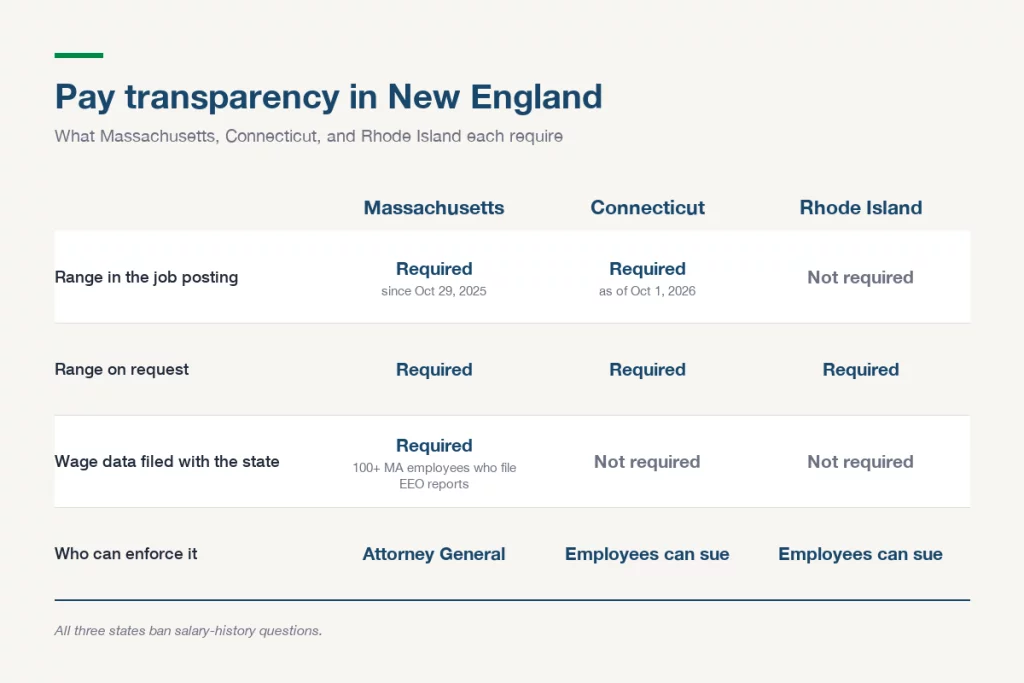
What your comp practices need to cover to comply
Here’s the thing other articles tend to skip: the number in the posting is just part of the job. The real exposure sits inside your existing pay practices.
When you publish a range, you’re making a public claim about what a role pays. If your current employees in that role sit below the range you posted, they’ll notice, and so will anyone weighing a wage-discrimination claim.
HR and compensation professionals continue to discuss the problems that surface once ranges go public: pay compression, outdated pay structures, inconsistent raises at promotion, and pay decisions nobody documented.
A posting range you can defend rests on the right comp practices. At a minimum, that means:
- Real pay ranges tied to the work. Ranges anchored to the role, the level, and the local market, not a number reverse-engineered to fit a posting. A range so wide it’s meaningless, like $45,000 to $150,000 for one job, fails the good-faith test and invites the scrutiny you’re trying to avoid.
- A reason for existing pay. You should be able to explain why two people in similar roles earn different amounts, using factors like experience, performance, and location, and you should have that documented.
- A pay-equity check before you publish. Transparency is what you disclose; equity is whether the numbers hold up. Running a pay-equity review before you post is how you find the gaps on your terms instead of an employee’s.
- Managers who can talk about it. A published range doesn’t mean everyone in the role earns the same, and your managers need a straight answer for the questions that follow the posting.
Pay transparency trips up companies that treat it as a wording exercise instead of a compensation exercise. The states that already require this have made your compensation structure the thing that matters.
Building pay ranges you can stand behind
If you’re staring at a posting deadline and wondering whether your ranges will hold up, that’s a good instinct, and it’s a solvable problem. The fastest way to start is to get your pay structure built the right way, so every range you publish is one you can defend.
Our team can build that structure with you through Compensation Plan Design, run a pay-equity review before your ranges go public, or embed an HR Business Partner to handle the whole thing alongside your team. Wherever you are with it, let’s figure out what your company needs to comply with confidence.