Key takeaways
- Included broker HR portals can be useful for the basics: templates, posters, handbook policies, and simple questions during business hours.
- It’s usually a resold national platform, most often Mineral or Zywave, gated by the tier you’re paying for, so a dedicated consultant appears only at the higher, pricier tiers.
- Generic content doesn’t localize to Massachusetts, Connecticut, Rhode Island, Vermont, New Hampshire and Maine law.
- Selling insurance is a broker’s main business, so HR comes bundled as a retention perk, which is why it tends to turn self-serve.
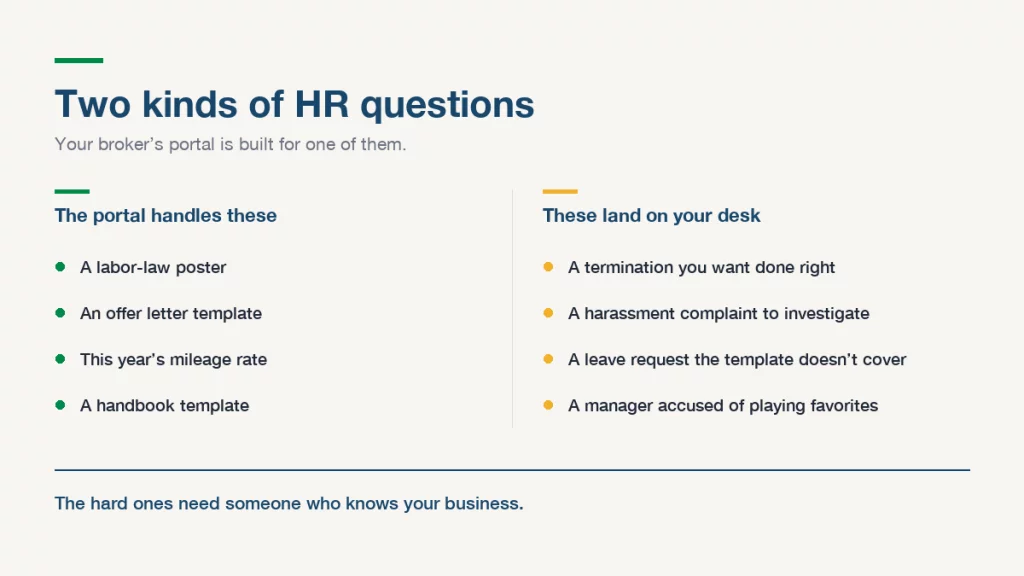
Most included HR from a benefits broker can work for simple everyday tasks. You need a write-up form or an updated labor-law poster, you log in, you grab it, you move on.
Then something real happens. A manager gets accused of playing favorites, an employee asks for leave you’re not sure how to classify, or you have to let someone go and want to do it the right way. You log in for backup and find a generic article or a support ticket queue. That gap between what the portal does well and what you need when stakes are high is worth understanding.
What a broker’s free HR portal is good for
The HR that comes bundled with your benefits usually includes a solid library: handbook templates, job-description samples, the labor-law posters you’re required to hang, an online course or two, and a searchable base of compliance articles. Most packages add an advisor line you can call or submit a ticket to during business hours with a quick question.
The thing is, most of these portals are the same product. Brokers rarely build their own. They license a national platform, usually Mineral (formerly ThinkHR) or Zywave, and put their logo on it. The content is broad and mostly up-to-date. It’s also the same content everyone else’s broker is handing out, and much of it you could find on your own for free.
If you’re not sure which one you’re looking at, the login screen usually tells you.
- Mineral came out of the 2019 merger of ThinkHR and Mammoth and took the Mineral name in 2021.
- Zywave, the other common one, has sold HR and compliance content through the broker channel for years and picked up HR360 in 2017.
- When Mitratech acquired Mineral in 2024, it put the platform’s reach at more than 2,500 brokers, carriers, PEOs, and payroll providers, which is why so many of these portals feel alike.
Where “free” HR turns self-serve, right when it matters
The trouble starts with the hard questions that carry serious consequences.
You’re weighing whether a termination is straightforward or a lawsuit waiting to happen. A manager is accused of harassment and you need to run an investigation you can defend. An employee requests leave, and the federal and state rules don’t match anything in the template library.
In those situations, a portal still just gives you an article and a form. The support system gives you a general answer from someone who doesn’t know your company, your history with the employee, or the specific facts.
Experienced HR people tend to draw a line here. Broker-included support is fine for plan and benefits questions. Once a situation becomes a people-judgment call or an employment-law question, you need dedicated expertise that knows your business, beyond what a broker portal offers.
Generic HR content can’t keep up with local and regional law
A national platform like Mineral or Zywave has to write for every state at once, which means it writes for none of them in particular. Covering 50 states well is the job they took on, and it’s a genuinely hard one.
For a New England employer, say you post a job. As of October 2025, Massachusetts requires employers with 25 or more employees to list a pay range in the posting. A generic template that hasn’t caught up can leave you out of compliance without your knowing it.
Now add Connecticut and Rhode Island, each with its own leave rules, notice requirements, and headcount thresholds, and a single national reference is working against you.
What a dedicated HR partner does that a portal can’t
A portal gives you content and a support queue gives you a general answer. A dedicated HR partner does the work with you, and keeps doing it as your company grows.
That’s the idea behind our RightFit HR service. You get a named HR Business Partner who learns your business and handles the real work, from the write-up and the investigation to the handbook and the hard conversation. Behind that one person sits a bench of specialists in compensation, benefits, employee relations, and coaching, plus legal resources to escalate to when a question crosses into legal territory.
A few things set it apart from a broker’s included HR:
- It’s independent. We don’t sell insurance or payroll, so there’s nothing else we’re angling to cross-sell you, and HR is the whole point rather than a perk protecting something else.
- You get a person, and a team. One HR Business Partner who knows your situation, backed by specialists instead of a rotating queue.
- It’s built for your states. Guidance and documents made for New England employers, kept current as the rules change.
- You can flex it month to month. Tiers you can move up or down as your needs shift, with no annual contract locking you in.
If your broker’s portal has started to feel like a login and a support ticket queue instead of a partner, it’s worth evaluating whether it’s working. If the answer is no, or even maybe, let’s talk about what real HR support looks like for a company your size. You can start with our HR Business Partners team.
If you’re weighing bigger changes too, two related reads help: what to consider before signing with a PEO, or after you want out, and how to outsource HR without losing the human in it.